Agent Bible
Wild Animals: Other
Agent
Bible
Wild
Animals: Other
Habitat:
Lizards may be found in tropical, semitropical, temperate and even alpine areas. They generally prefer forested areas when the temperature allows them to be active even under the tree cover, or open areas where they can bask in the sun to warm themselves up in the morning. Most lizards are carnivorous, eating prey that depends largely on their size - anything from insects upto to small mammals, other lizards, eggs, birds and young animals. There are some lizards that specialise in eating fruit or flowers, but these tend to be found at lower altitudes in forest. Lizards do not seem to have a social structure as such, but do seem to tolerate each other quite well. They may have a home territory that could be as small as a single tree that they catch insects on to a large area of land through which they roam looking for mammals. they are egg layers, and often show no parental care beyond choosing an appropriate nursery site. Most lizards rely on their good vision to help them track down prey. They do not 'taste' their environment in the same way as snakes, but can also pick up a lot of information from vibrations. Some of them may be able to see in the dark, although it is thought that all lizards have black and white vision only.
3
Habitat:
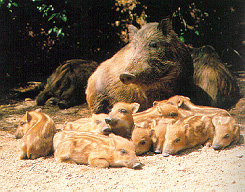
Boars tend to favour lightly forested areas, where they can rummage around for food, but are not so hemmed in by vegetation that they cannot see approaching danger. They also enjoy venturing out onto open land to sunbathe, and usually include some stream or marsh in their territory for the all-important mud bathes they favour. They are found in tropical to temperate areas and increasingly also close to farmland where they are becoming a real pest. Wild boar use their snouts and tusks to dig up roots, tubers, fungi and bulbs that form a major part of their diet. They also gorge themselves on fallen fruit in the right seasons, and eat green shoots. They are becoming a major pest of agricultural land as they can easily decimate a field of root crops or new crops overnight. They also eat carrion, eggs, insects, and happily root through waste tips looking for something to snack on. their reputation for eating everything they find is not entirely accurate, but not far off the truth. Female boars gather together with their young in groups of upto 20 animals - usually called a 'drift' or 'sound' of boars. The males tend to be solitary or form loose groups, but are rarely seen until their fourth or fifth year when they begin to breed. female drifts hold large loosely defined territories and the males wander in and out during the breeding season, fighting on occasion to breed with the fertile sows. males are not usually aggressive unless provoked, but a female with young will attack anything that comes close to her and can be fatal easily. In the wild, boars tend to be more active at dusk, spending the heat of the day lounging around in the shade, or taking mud baths to keep cool. Wild boar have an excellent sense of smell - they have one of the most powerful noses in the animal world. They can distinguish between different types of roots even before they dig them up - saving time if they don't like that particular root. Their hearing is also excellent and combined these sense keep them out of trouble. their eyesight is good, but limited in range - earning them the label of being 'short-sighted'. Sensory bristles all over their bodies help to collect information on wind directions or approaching danger.
3
Habitat:
Found roosting in caves, houses, temples, trees and many other dark, undisturbed places. A bat will roost in the same place it was born for most of its life unless it is disturbed, and they have established areas that they prefer to 'commute' to at night to feed. Bats are a diverse group of animals and cover pretty much all food groups between them. Some eat fruit and leaves, others insect, spiders and three creepy-crawlies. There are species of bat that even fish in rivers or drink blood - although not in Tibet. Most bats catch insects as they fly through the night air, using their ultrasound to locate their prey. Bats are quite sociable in that they tend to share roosts with each other for the duration of their life. A bat gets to know its roost neighbours very well, and in dire need may even be able to beg food off them. They give birth to live young during their 'hibernation' period - tropical bats do not hibernate, although they may do so at higher altitudes. Bats have excellent sight, but as they fly mostly at night, they also depend on their echolocation (sonar) for navigation; each species has a different frequency that they use, so they do not block each others signals! Navigation through dark spacesRecent research has discovered that bats actually have good vision, but tend to rely on their echolocation for navigating during night. They make high-pitched squeaks which are then received by their huge ears and even noses in some cases. These squeaks are accurate enough for them to be able to identify individual types of flying insects in pitch black, as well as tell the size, condition and location of their prey.
aura weight length size intelligence domesticity 3 15kg 60cm 3 6 4
Habitat:
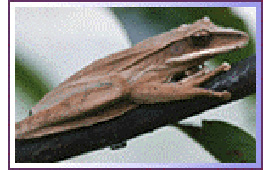
Most of the frogs species found in Tibet will be found in the lower western edge of the country either in forest or near to water. There may be some in the rivers and lakes on the steppe, but these will be fewer in number and diversity than those lower down. Frogs tend to be insectivorous, although some may take small mammals, other amphibians and even each other. Grogs tend not to stray too far from a source of water whether this is a lake, river or small cup of water held in a plant living on another tree. They have to lay their eggs in water and their delicate skins must be prevented from drying out as well. they usually return each year to the same place to mate - usually he place they themselves were born in - where males compete for access to the females. some frogs may hibernate, but these will usually be those found at higher altitudes, where hibernation is the only option for surviving the harsh winters. Frogs have the uncanny ability to 'taste' their environment with their skin as long as it stays wet. Sensors detect smell particles that dissolve n the mucus covering them. Their sense of hearing is also quite acute, but tends to tie closely to the range of notes that make up mating calls - for example, bullfrogs have a good low frequency hearing, but loose higher notes. for the most part, their vision is excellent but largely centres on movement.
aura weight length size intelligence domesticity 3 15kg 60cm 3 6 4
Habitat:
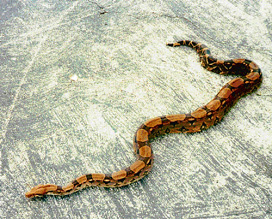
Snakes tend to be found in the same areas as lizards - usually tropical or semi-tropical forest, although some species may be found as high as the steppe. Snakes are carnivorous entirely, although their diet may also include eggs of birds, insects and even each other. Snakes from higher altitudes may hibernate underground or between boulders in a pile. At these times, disputes is put aside as many snakes share the same space to keep warm - as they wake up in spring, they often mate before they disperse. Again, snakes are egg-layers and usually show no parental care. Most snakes have excellent vision, although usually only at close range. Many of them complement this by using infra-red/heat sensors as well, allowing them to detect their warm prey even in pitch blackness. Their tongue and mouth have sensors that collect smell particles and 'taste' them, increasing their chances of detecting anything interesting. As the crawl along the ground, they use their entire body as a vibration sensor, and their hearing is also very acute, being tied into the he vibrations that they feel.
aura weight length size intelligence domesticity 3 15kg 60cm 3 6 4 (note: ratings and statistics are game stats only and may have been rounded or abstracted) ©2003 Gameware Development